
For March’s T-SQL Tuesday invitation, Damien has asked us to consider a wish list for Microsoft’s partnership with OpenAI.
AI has been a hot topic in recent months, largely due to the attention from tools such as ChatGPT and DALL-E from OpenAI. These tools and future iterations or derivatives will almost inevitably shape the way we interact with technology in the near and longer term.
With regards to the particular question posed by Damien, there are two particular areas where I’d like to see this type of technology leveraged by Microsoft moving forwards:
Analytical context
From past experience the immediate thought which came to mind where I feel there’s a large opportunity for AI is in applying context to analytical data…
When providing analysis within a business it is typically much easier to explain what has happened as opposed to why it happened. The facts about our business – it’s sales, customers, KPIs, or other metrics – are usually well defined and tracked so providing this information is common place. The understanding of why those metrics move is where I’ve seen challenges.
Change within an organisation can sometimes be tracked and correlated, for example an increase in sales during a promotional period. Additionally there may be known and understood variations such as bank holidays when locations may be closed which could be factored in. However, what about less tangible factors such as weather conditions or changes in local demographics over extended periods. Most of this type of data is available through various sources or public repositories such as APIs or government census data.
The ability to access and consolidate a number of these sources and then trying to model those and correlate with your own data can be extremely challenging or time consuming. Being able to utilise an AI model which is already aware of those factors (and many more) and can understand a business, it’s services, and align against any environmental factors which could influence it in real-time would bring immense value.
With the current ChatGPT model it has limited knowledge of events after 2021 however over time it’s almost certain that regular training of these models will bring them right up to date with current world events and trends. This type of knowledge could be further leveraged within analytical tools to help understand outliers or parallel trends within an organisation’s own data.
Being able to integrate true AI into a business in this way would not only help to understand historical events but may also help to provide more accurate forecasting in the future. If it were understood that a period of increased sales were due to a viral trend then future sales could be predicted excluding those from the forecasting model to provide a more accurate estimation. Another example would be if a trend starts to emerge which could lead to an increase in demand then production could be ramped up much more proactively and with greater accuracy in anticipation for the demand.
Enhancing search
The next opportunity which I considered was very much a quality of life change centred around conversational search. This one appears to be closest to fruition currently given the work by the likes of Microsoft and Google, but I felt it was worth covering as it’ll have the broadest visibility to the public.
At times it can be an art in itself to effectively search, particularly when trying to troubleshoot complex or obscure situations. With that said there’s a large portion of search usage which could be considered trivial when we’re after quick answers to straight forward questions and AI could help reduce friction getting to these answers.
If you’re looking for the release date of a movie then you’ll immediately get the answer, likely along with details of where you can stream or watch locally in a cinema. The way that these results are presented is very purposeful and specific to the question. If we ask how to create a foreign key constraint we aren’t presented with code, rather a list of links to various sites explaining this in different ways.
Why can’t search just give us the answer right there and then? With these AI tools being able to accurately answer factual questions of this nature it’s very feasible that a short synopsis and some sample code be be produced to answer the question without any need to dive onto other domains. Would you prefer scouring through documentation or a variety of forums and blog posts to find the answer or see something like below (taken from ChatGPT)?
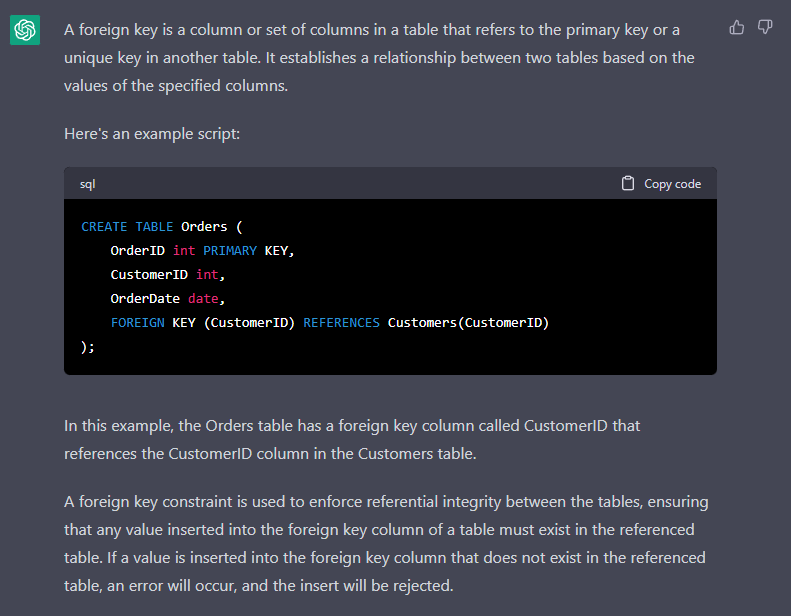
From the perspective of the end user this should mean faster access to answers which are accurate and concise, and ultimately save time searching for the relevant content in the top results. Conversely for content creators the impact this could bring is lower traffic figures to their domains whilst the search providers would prefer to keep traffic (and potential revenues) on their own.
Within the data world for example I don’t see that this type of improvement would remove the need for well thought out deep-dive technical documentation or very niche specific situation analysis or troubleshooting as they are both very specific and tailored content. This would be about taking the lower hanging fruit which may be easier to convey in a short form.
Wrap up
Advancements in AI and their proliferation in recent months feels like cracking open Pandora’s box for a peek into what is around the corner. I have no doubt that we’ll see similar revolutionary use cases in the near term which will bring with them a host of opportunities for unlocking growth across our industry.
These two areas are the ones which initially jumped out at me but even these will be extended as time goes on – it many not be too far away when we’ll have our own AI within our organisation consuming all its data, documents and conversations to be the ultimate source of knowledge, or how about taking all of that knowledge and being our initial point of contact for queries at all levels of the organisation? That’s all certainly coming somewhere down the pipeline and it’ll be very interesting to see how the landscape looks when it arrives.
At the end of the day the tech giants are out there competing to drive value for their businesses, however it will be the wider population where these impact from these tools will be felt the most, whether that be within their own organisation or their personal time interacting with technology. Personally I’m very optimistic for AI and the opportunities which it’ll bring with it. As with everything it’ll be great, in moderation. Or the robots may well take over…
 Andy Brownsword